
Independent Reporting · Serving Our Veterans
AmericasLove.org · Special Report
Robert Xavier Steele of North Las Vegas says he can knock an enemy drone out of the sky for less than a dinner for two at Ruth's Chris Steak House. On August 6 he mailed it to the Pentagon, certified, and started a thirty-day clock.


Robert Xavier Steele.
He is sixty-two. He swears like a marine using the F-word as a verb, an adjective, a descriptor and sometimes for punctuation. He answers his own phone, which I know because I called it twice before I flew out and he picked up both times, on the second ring, sounding annoyed.
Let me lay out the problem first, because the problem is the whole story.
There's a drone hunting an American squad tonight. It's a toy aircraft that can fly up to 200 miles an hour, and they've got to hope they can hit it in the last 100 yards before it turns them all into bologna mist. And that's, of course, if they hear it in time and have the right weapon, because quite frankly you're not going to take it down with a single bullet from an M4 rifle. And in most cases, if it's close enough that you can hear it, you're already screwed. You start to hear a drone about 100 yards away, but most of the time it's only about 25 yards if we're going to be honest, with a good wind and some vegetation to block the noise. They have seconds, because they can't start hunting it back at 300 yards when they could actually hit it, because then they'd have time to take a couple of shots instead of just the one.
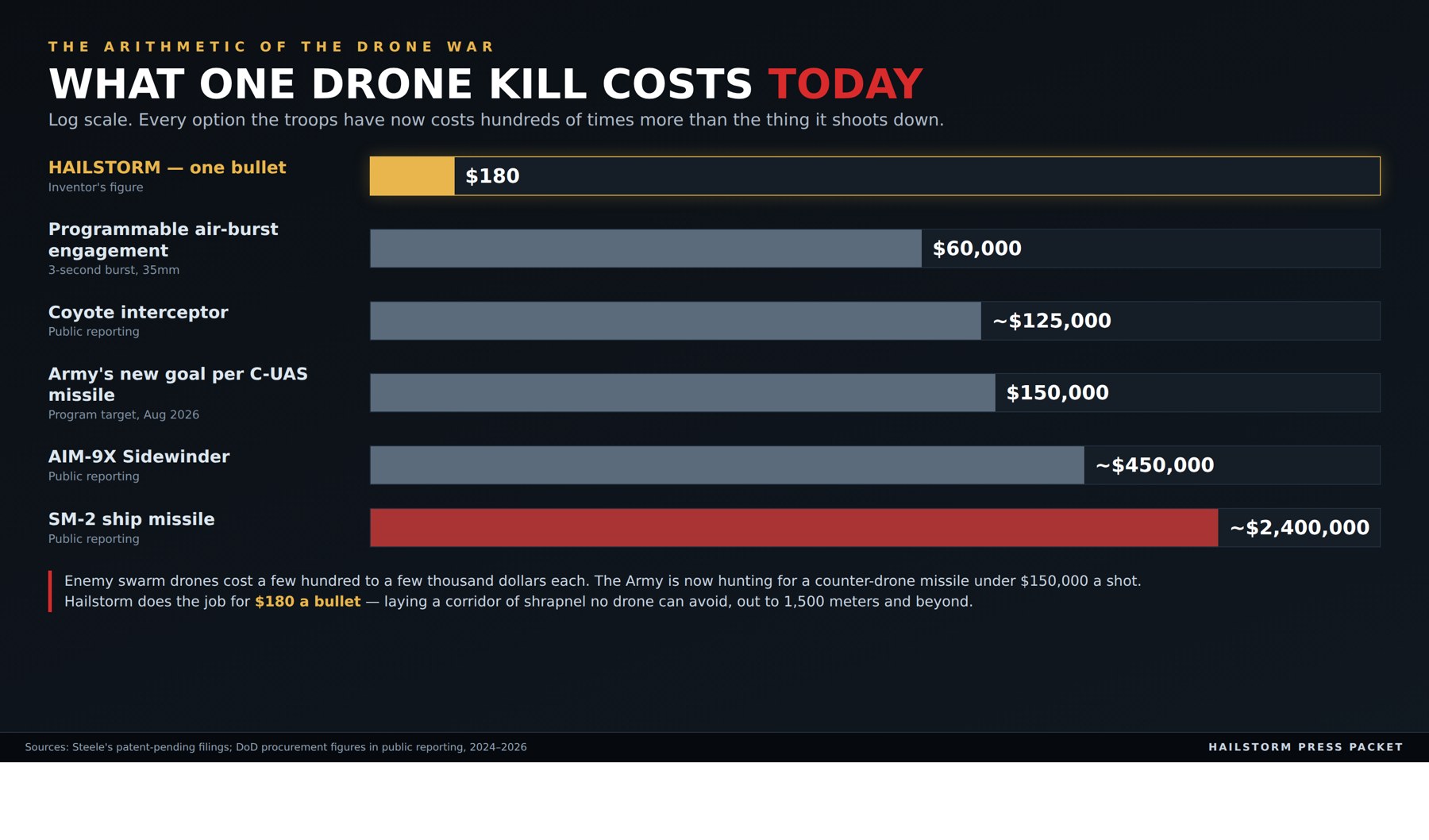
The missile the United States fires to stop that toy costs somewhere between $125,000 and $2.4 million.
Sit with that for a second. A hobby store aircraft with explosives taped to it, and the answer we've got costs as much as a house. A high schooler can do this arithmetic, and so can every adversary we've got. Nobody has to beat America on a battlefield anymore. They just have to make America spend half a million dollars a shot, again and again, until the racks are empty and the factories can't refill them fast enough.
How do I know the racks are getting empty? Because this year the Army went shopping for a counter-drone interceptor it could buy for under $150,000 a shot. When your bargain hunt starts at a hundred and fifty grand, you've told everybody what the ones in the magazine cost.
Steele's design is called Hailstorm, and the idea is almost insulting in how old it is. Quit trying to hit the toy. Fill the sky it has to fly through.
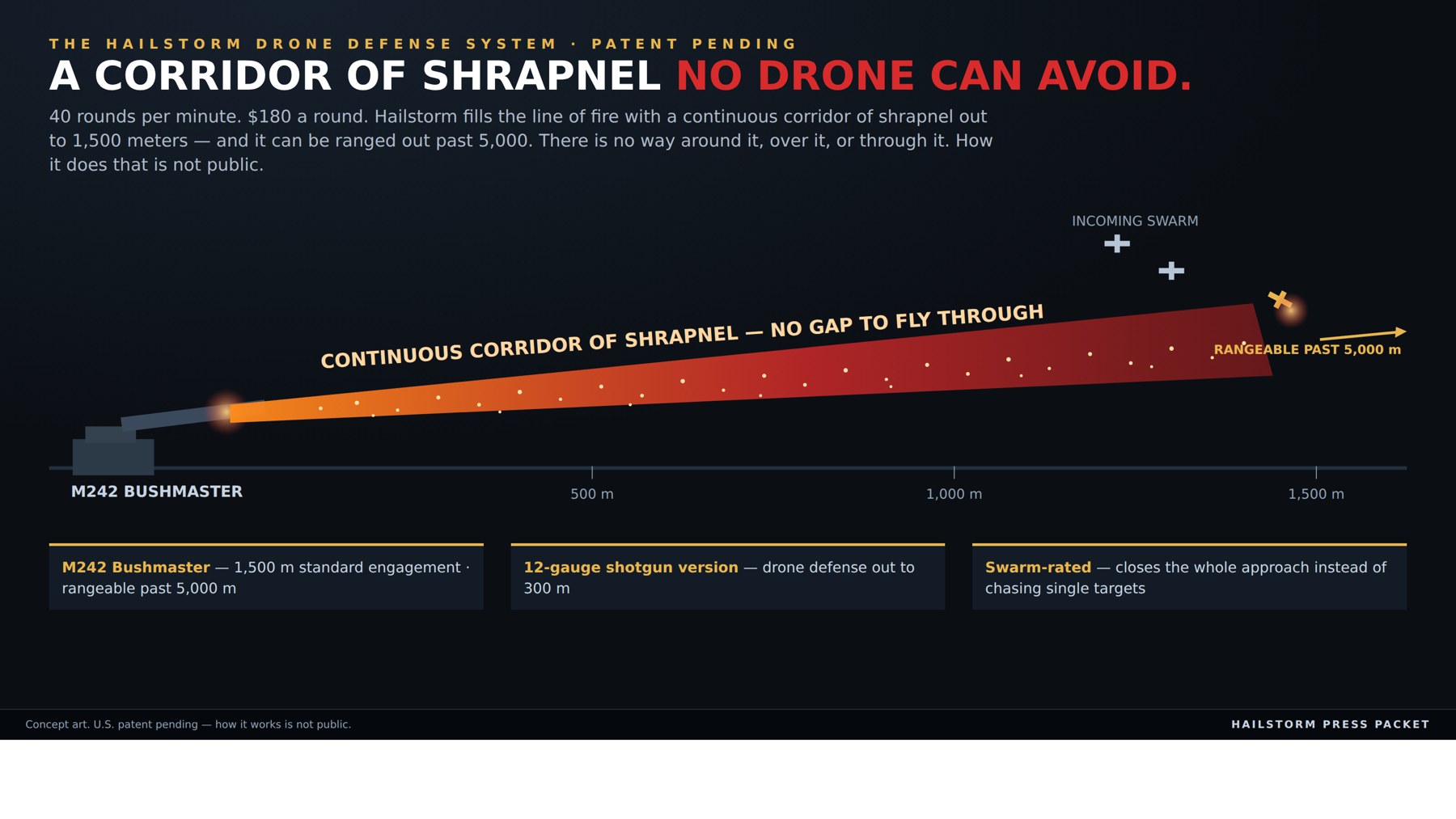
The round is built for the M242 Bushmaster, a 25mm chain gun the United States already owns by the thousand and keeps parked in desert storage. Fire it at forty rounds a minute and, by Steele's figures, the bullets open into a moving corridor of shrapnel traveling 1,500 feet per second: a wall of steel out to 1,500 meters, rangeable past 5,000.
"It ends up acting like a fire hose of shrapnel coming from the gun," he said. He said it the way you'd describe a garden hose.
There's a 12-gauge version that does the same thing over a rifle squad out to 300 meters, and he says it ranges to 700. There's a version for the M27 and the M4 that he puts at 500 meters and better.
Cost per round: is $180 for the M242 Bushmaster 25mm.
I asked how the round does what it does. He said no. It's in the pending filings, it isn't public, and he isn't going to hand it to me so I can put it in a magazine. Fair enough. I'd have thought less of him if he'd told me.
Most people who mail the Pentagon an invention are asking for a program. Invent it, fund it, test it, build a plant, field it in six years, and by the way here's a budget.
Steele is asking for almost none of that, and the reason is the gun.
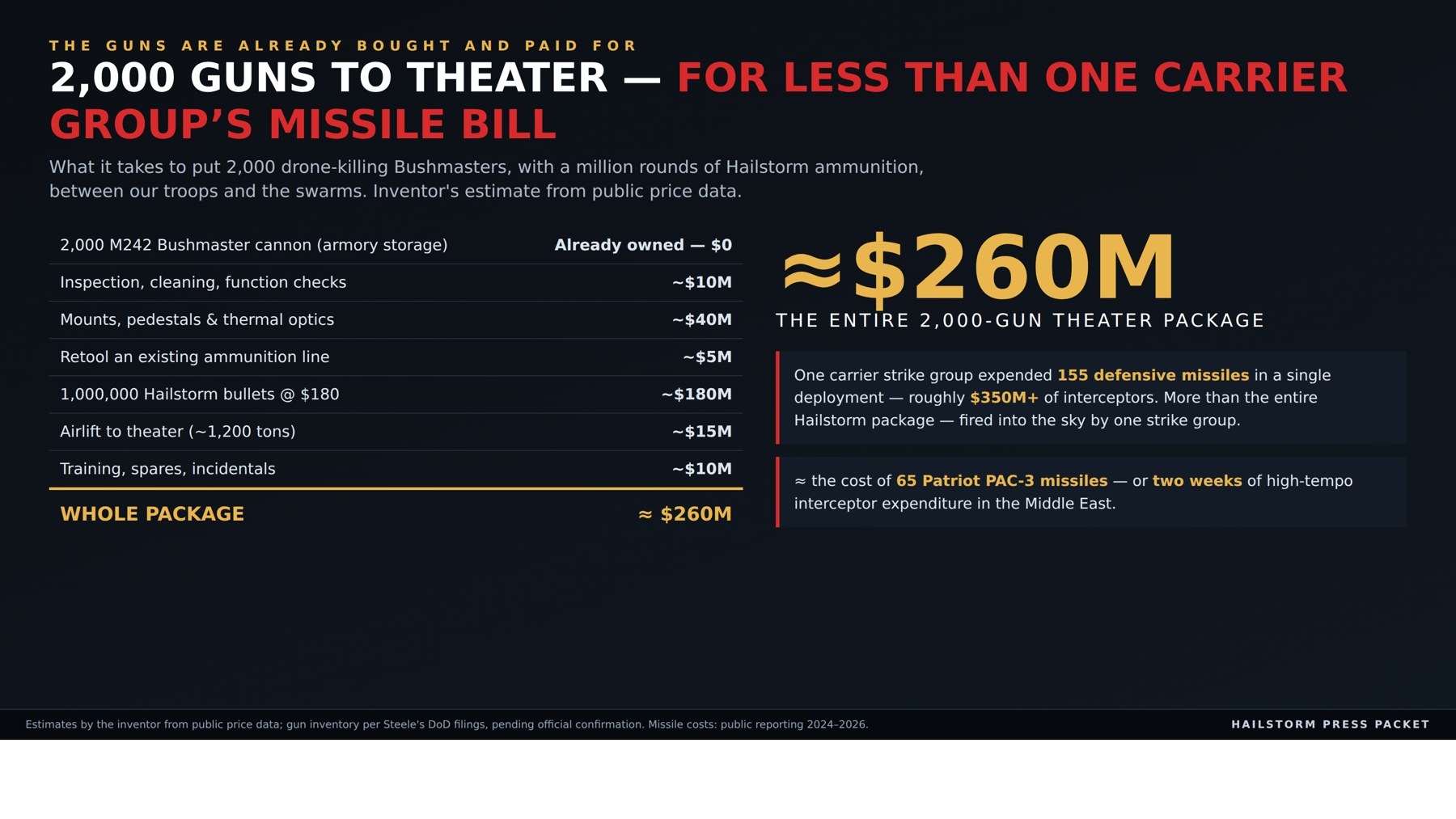
There are roughly 2,000 M242 Bushmasters sitting in American inventory right now. Bought. Paid for. Nobody has to design them or appropriate a nickel for them; they're in storage under a coat of grease, waiting. The only genuinely new object in this whole proposal is the bullet.
His estimate for pushing 2,000 of those guns into theater with a million rounds, plus mounts, thermal optics, airlift, training and spares, is about $260 million.
Here's the comparison he wants you to make, and I checked that the comparison is at least fair on its face. One carrier strike group burned through 155 defensive missiles in a single deployment. Call it $350 million of interceptors, fired into the sky by one strike group, in one deployment.
So the entire theater package costs less than what one strike group already spent shooting.
The fielding schedule Steele filed is aggressive to the point of being rude, and he won't walk it back an inch.
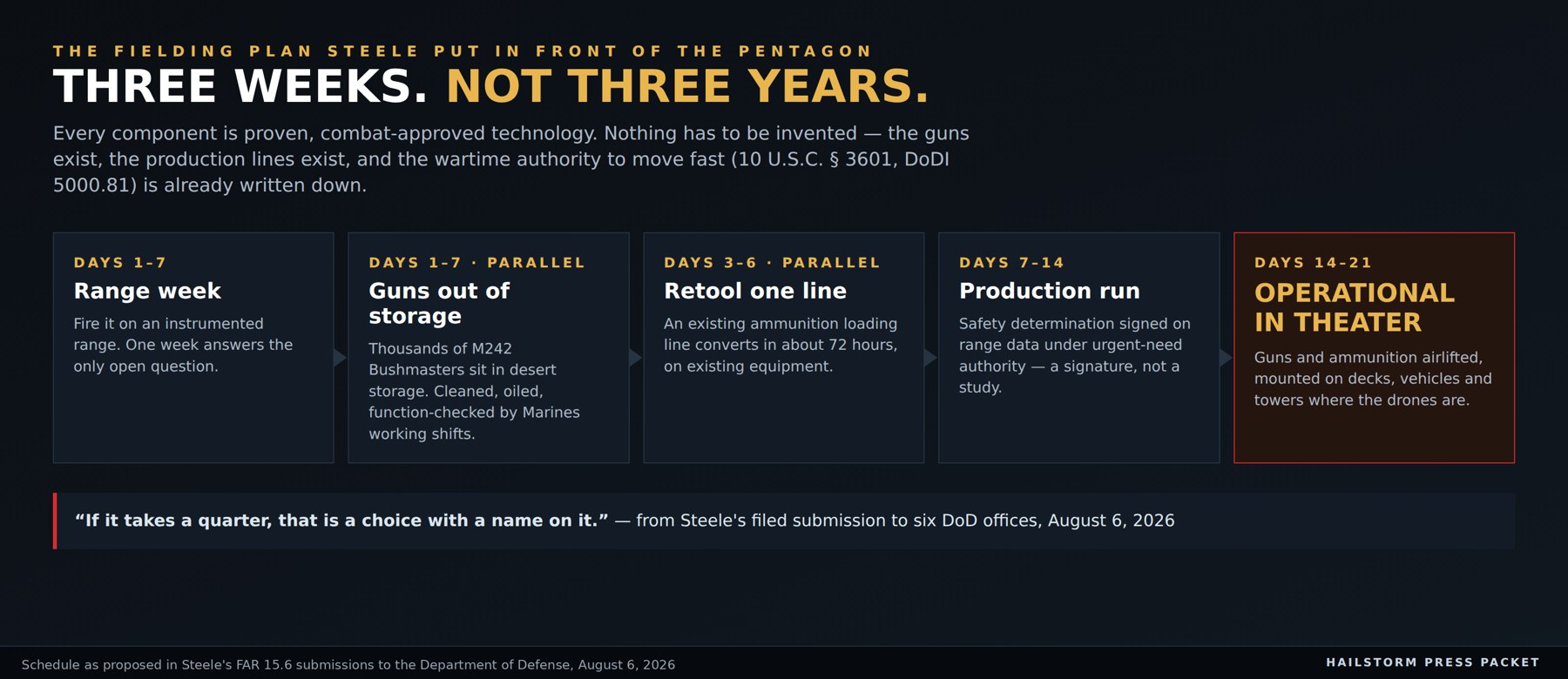
One week on an instrumented range, which he says settles the only real question. Guns pulled from storage in parallel, cleaned and function-checked. An existing ammunition line retooled in about 72 hours on equipment that already exists. A production run. A safety determination signed on range data under urgent-need authority, and he's careful to point out that's a signature, not a study. Then airlift, and mount them on decks and vehicles and towers.
"If it takes a quarter, that is a choice with a name on it," he wrote in the submission. I read that line three times.
He mailed it. Certified, stamped, postmarked, receipted.
It went to the Department of Defense, and it went to his congressional delegation: Senator Jacky Rosen, Senator Catherine Cortez Masto, and Representative Steven Horsford.
The Marine Corps Warfighting Laboratory got it by email, at mcwl_pao2@usmc.mil, which is the address the Lab publishes at mcwl.marines.mil.
Then he scanned the green receipts and published them, which is not a thing people do when they're bluffing. Call any of those offices. He says he'll wait.
He also started a clock. Thirty days.

I've written enough of these to know the usual ending. An outsider with a decent idea mails it to an institution built to absorb decent ideas. It gets logged, it gets filed, and that's the last anybody hears about it. Nobody's being evil. The building is just very, very large, and large buildings do not turn quickly for one man with a landline.
What makes this one awkward to file away is that the arithmetic is out in public now, and it isn't close.
He's got no lobbyist, no investor deck, no communications staff, and no booth at the trade shows.
He describes himself as a hard-headed old man who swears too much, and as a crazy scientist who honestly can't tell you which side of the genius-or-insane line he's standing on. "It's a thin line," he told me, "and I've been walking it a long time."
I asked the obvious question. Why hand this to reporters instead of quietly selling it to somebody with a procurement office?
"I'm worried about the kid standing behind a gun in the Middle East tonight," he said. "He didn't pick this war, and he didn't pick my politics either. But he does need my bullets, and the guns in storage, to survive. And that is all I really care about."
He knows his manner isn't going to help him in a briefing room. He does not appear to lose sleep over it.
"You're free to hate my politics," he said. "Take a number. The line forms behind my wife."
I'll admit I laughed. Then I looked at the receipts again.

The bullet isn't the only thing he's been working on, and the second one told me more about him than the first.
Fifteen million acres of the world's farmland is locked up behind landmines from wars that ended before most of the people farming near them were born. Seven kids a day lose legs or lives to old ordnance. Steele's answer is a spiked roller sled he calls the D-Miner: concentric steel pipes packed with rebar, mesh and concrete, six armored drums hung on two booms, shoved along in front of an ordinary farm tractor at over fifteen miles an hour.
Three drums run the same lane, one behind another, so whatever the first one misses the second or third one eats. He puts clearance north of 99%, build cost around $8,700, and coverage at roughly 17 acres a day. When a mine chews up the outer skin you fix it with a grinder and a bag of cement. And give it 30 minutes to cure and you're back up and running.
That one he's giving away. His patent pending means no one will ever pay to use his design. The only reason he hasn't published details on it yet is because he hasn't tested it to make sure it's not gonna blow up in somebody's face the wrong way. It's one of the reasons he was hoping to get the Marine Corps to help him, in the spirit of their love of kids with Toys for Tots each year.
I thought maybe they would go big and think about giving just 2,200 kids their lives and limbs back this year. Might be a nice present. Build it, put it on YouTube, and show everybody else how to build their own, so we can get this done in under a year. Like, we are the United States Marine Corps. We are the good guys. Even if it doesn't always feel like it. You and I both know, if we can make it right, we should make it right.
The D-Miner is one item on a long list. He keeps the rest at USLove.org: the drone fleet he thinks the country should be building instead of more jets, a plan to refinance private student loans through the Fed, a working-class college model, and a proposal for keeping a runaway AI from ending us.
See the rest of his ideas at USLove.org
Whether Hailstorm works the way he says is a question for the Marine Corps Warfighting Laboratory, and it's exactly the right question. Steele isn't asking anybody to take his word for anything. He's asking them to put it on a range and shoot it, which is the one favor an inventor with a bad idea never asks for.
The clock started August 6.
He's worth meeting in his own words, and he doesn't tidy himself up for company. His site is abadmarine.com. Go read it. Bring a thick skin.
Press inquiries, documents and hi-res graphics: yudhamasanto@americaslove.org
Figures attributed to Robert Xavier Steele are his own estimates, drawn from his patent-pending filings and public price data. Missile and interceptor costs come from public reporting, 2024–2026.